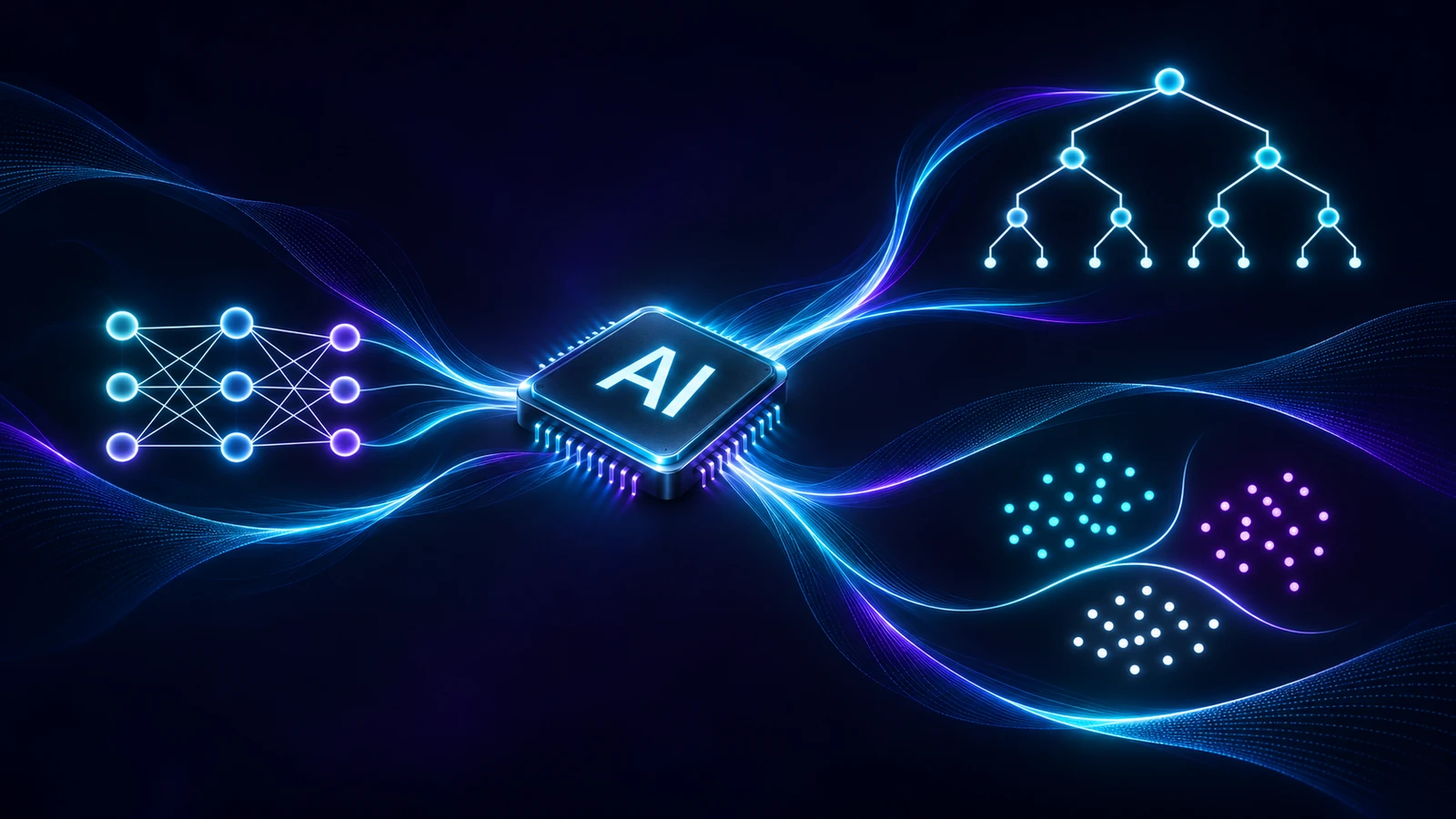
Decision Tree, Transformers, Diffusion, RAG. We encounter these names in products, projects, and professional conversations, but what is behind them? What problem does each method solve, and how does it arrive at a result?
We created this guide to make these ideas clear and tangible. Each entry explains the method, describes how it works, and provides examples of its uses. Alongside the explanations, interactive demonstrations let you change inputs and settings to see how the results change. The guide also includes code walkthroughs and Python examples you can copy and download.
What Can You Discover in the Guide?
Select a topic to explore the family, or an algorithm to open its interactive example.
- Prediction and classification: How regression, decision trees, and random forests use data to predict a value or classify cases into groups.
- Patterns and anomalies: How methods find groups in data, identify unusual cases, and generate recommendations.
- Language, images, and audio: The principles behind models for text processing, object detection, and transcription.
- Content generation: How models generate text and how diffusion processes turn noise into images.
- Search, planning, and decision-making: How methods rank information, incorporate sources into answers, and use feedback to improve choices.
Who Is the Guide For?
The guide is intended for students, developers, data professionals, product managers, and business leaders, as well as anyone interested in understanding the algorithms and models underlying artificial intelligence.
No prior knowledge of machine learning is required. The explanations present the principles in clear, precise language, while the demonstrations and code examples offer a deeper look at the calculations and implementation.
Whether you are exploring the subject for the first time or bringing professional experience, the guide offers a way to broaden your understanding of AI algorithms and models. The explanations, demonstrations, and code examples are available for you to explore and experiment with at your own pace.
Planning to bring AI into your own systems? See how we build integrated AI solutions.